Most international freight today moves in standard shipping containers. But what happens when your cargo is too large, too heavy, or too awkwardly shaped to fit inside a container, or even on a flat rack?
That’s where breakbulk shipping comes in. It’s one of the oldest methods of moving goods by sea, and it remains an important option for businesses shipping heavy equipment, oversized structures, and large industrial components.
If your business moves big, heavy cargo overseas, understanding breakbulk shipping can help you plan more effectively and choose the right transportation method for your shipment.
What Is Breakbulk Shipping?
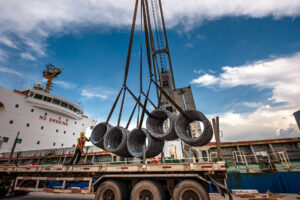
Breakbulk shipping refers to cargo that is loaded onto a vessel as individual pieces rather than inside shipping containers. Items may be lifted onto the ship by cranes, loaded on skids or pallets, placed in crates, or secured directly in the vessel’s hold or on its deck.
The term comes from the idea of “breaking” a bulk load into separate pieces that are handled one by one. Unlike bulk cargo, such as grain or oil, which is poured or pumped into a vessel, breakbulk cargo consists of distinct units that are each handled individually.
Breakbulk shipping is commonly used for:
- Heavy industrial machinery
- Power generation equipment such as turbines and transformers
- Construction and mining equipment
- Steel beams, pipes, and structural materials
- Large tanks, vessels, and boilers
- Railcars, boats, and other oversized vehicles
- Components for energy and infrastructure projects
How Is Breakbulk Different From Container Shipping?
Breakbulk and container shipping both move cargo by sea, but they work very differently.
Cargo Size and Weight
Container shipping is limited by the dimensions and weight capacity of the container. Breakbulk shipping can accommodate cargo that is far larger or heavier, since it isn’t confined to a box.
Loading and Handling
Containers are loaded quickly using standardized port equipment. Breakbulk cargo is handled piece by piece, often with cranes, heavy-lift gear, or the vessel’s own lifting equipment.
Vessel Type
Container cargo moves on container ships with fixed schedules. Breakbulk cargo often moves on general cargo vessels, multipurpose ships, or heavy-lift vessels, which may operate on different routes and schedules.
Port Access
Container ships generally call at major container terminals. Breakbulk vessels may be able to access a wider range of ports, including smaller ports that are closer to a project site.
When Does Breakbulk Shipping Make Sense?
Breakbulk isn’t the right choice for every shipment, but it can be a practical solution in certain situations.
When Cargo Won’t Fit in a Container
If an item is too large for a standard or specialized container, breakbulk may be one of the few available ocean options.
When Cargo Is Extremely Heavy
Some machinery and components exceed container weight limits. Breakbulk vessels and heavy-lift equipment are designed to handle these loads.
When Disassembly Isn’t Practical
Some equipment can be broken down to fit into containers, but disassembly may add cost, time, and risk. In some cases, shipping the item whole as breakbulk may be the better option.
When the Destination Has Limited Container Infrastructure
Some destinations don’t have the equipment or terminals needed to handle large container volumes. Breakbulk may offer access to ports that are better suited to the project.
What to Consider Before Shipping Breakbulk Cargo
Breakbulk shipments require careful planning. Before booking, businesses may want to consider several factors.
- Accurate cargo details: Exact dimensions, weights, and lifting points are essential for vessel planning and stowage.
- Packaging and protection: Cargo may be exposed to weather and handling stress, so proper crating, wrapping, or securing is important.
- Vessel availability: Breakbulk sailings may be less frequent than container services, so booking early can help.
- Inland transportation: Moving oversized cargo to and from ports may require special trucks, permits, and route planning.
- Insurance: Because breakbulk cargo is handled more often, many businesses choose cargo insurance for additional protection.
- Customs and documentation: Heavy equipment shipments must meet export and import requirements in both countries.
Working with a freight forwarder that understands ocean freight for heavy cargo can help businesses navigate these details and avoid costly surprises.
Breakbulk Shipping and Customs Clearance
Large equipment shipments often involve high-value goods, detailed classifications, and specific documentation. Errors in paperwork or tariff classification may result in delays, inspections, or added costs at the destination.
Professional customs clearance support can help ensure documentation is accurate and complete, which may reduce the risk of cargo being held at the port. For project-based shipments with tight deadlines, avoiding customs delays can be especially important.
Frequently Asked Questions About Breakbulk Shipping
Here are answers to a few questions businesses often ask about breakbulk cargo.
Is breakbulk shipping more expensive than container shipping?
It depends on the cargo. Breakbulk may cost more for items that could easily fit in a container, but it can be more cost-effective for oversized or extremely heavy items that would otherwise require disassembly or special handling.
How long does breakbulk shipping take?
Transit times vary based on the route, vessel schedule, and port operations. Because breakbulk sailings may be less frequent, it’s helpful to plan well ahead.
Can breakbulk cargo be combined with container cargo?
Yes. Many large projects use both methods, shipping smaller components in containers and oversized items as breakbulk.
Choose Baum Shipping for Heavy Cargo Shipping
Breakbulk shipping requires coordination, experience, and attention to detail at every step. Baum Shipping has been a licensed air and ocean freight forwarder since 1984, helping businesses ship large and heavy cargo to destinations around the world.
From evaluating cargo and arranging ocean transportation to coordinating customs clearance and final delivery, Baum Shipping can help simplify the process of moving oversized freight overseas.
Need help shipping heavy or oversized cargo?
Contact Baum Shipping today at (800) 383-3157 to discuss your shipment and request a customized freight quote.